Two metrics for evaluating agents whose behavior varies between runs. They look similar; they answer opposite questions. Picking the right one is a product decision, not a math one.
The Problem
Agent runs are non-deterministic. The same task can succeed on one trial and fail on the next. A single pass/fail number hides this. Two metrics make the variance visible.
If you only run one trial per task, you miss this entirely; some tasks will succeed flakily, others will fail flakily, and a small change in either could move your “score” without telling you anything real.
Definitions
pass@k — at least one success in k attempts
The probability the agent solves the task in at most k tries.
- Rises with k. More shots on goal → higher chance at least one lands.
- pass@1 is the per-trial success rate.
- Used heavily in coding evals: in many code workflows we only care that the agent eventually finds a working solution.
pass^k — every one of k attempts succeeds
The probability the agent solves the task on all k consecutive trials.
- Falls with k. Harder bar to clear with more trials.
- If per-trial success rate is p, then pass^k = p^k. At p=0.75, k=3, pass^k ≈ 42%.
- Used for customer-facing reliability, where users expect the agent to behave the same way every time.
How They Diverge
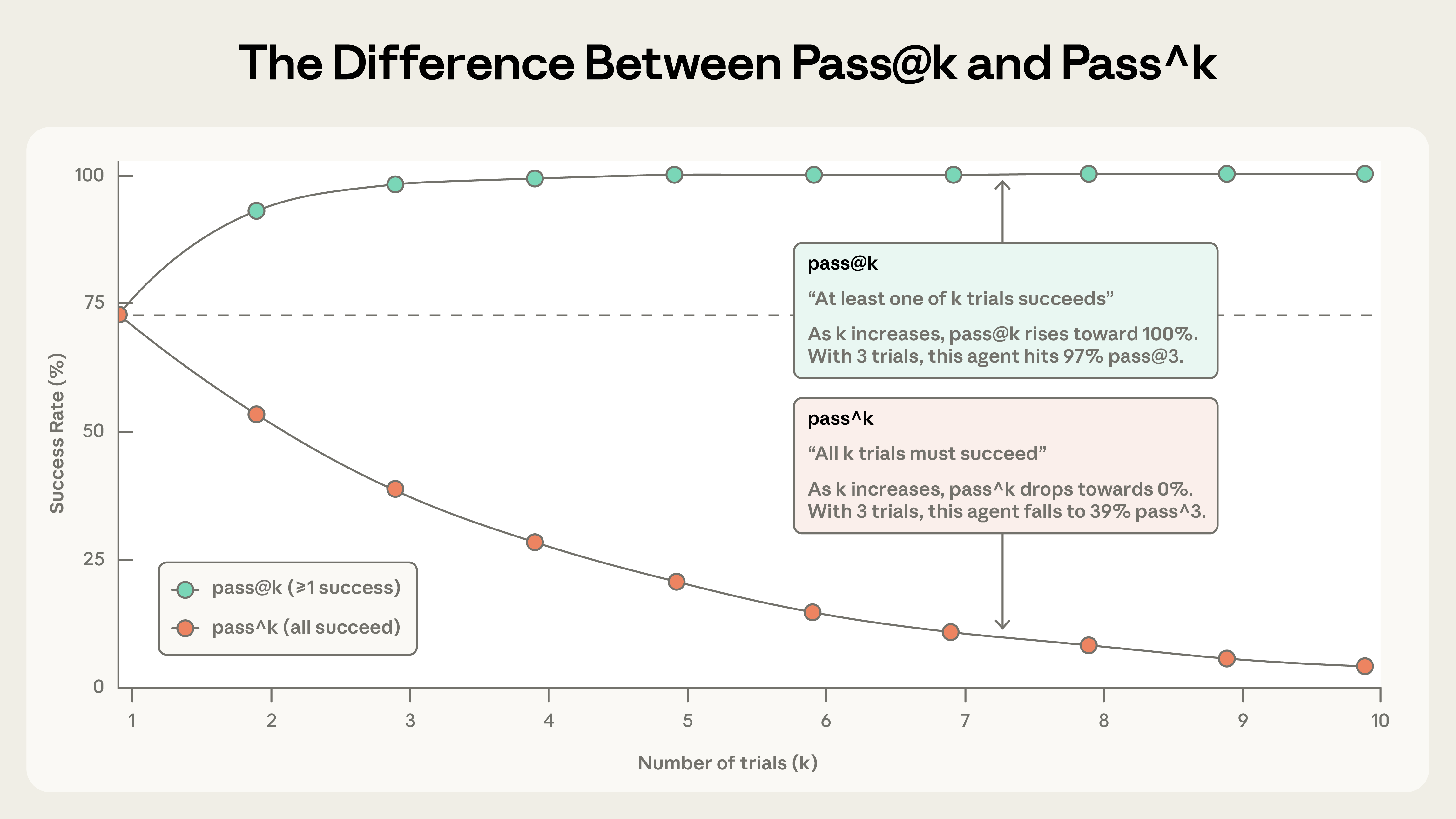
At k=1 the two metrics are identical (both equal the per-trial success rate). They diverge as k grows.
- pass@k → 100% (almost any non-trivial agent eventually succeeds at something)
- pass^k → 0% (consistency across many trials is brutal)
By k=10 they tell opposite stories about the same agent.
Which to Use
Match the metric to the product, not to convention.
| Use | Pick | Why |
|---|---|---|
| Code agent that proposes; human reviews and accepts | pass@k | One success is enough; reviewer filters out the misses |
| Code agent that auto-merges or auto-deploys | pass^k | A single failure causes a real outage |
| Research agent producing an answer the user verifies | pass@k | One good answer is fine; user sees it once |
| Customer support agent talking directly to users | pass^k | Every conversation needs to land; one failed refund is a complaint |
| Computer use agent driving a critical workflow | pass^k | Repeated reliability is the product |
| Brainstorming agent proposing options | pass@k | Many options is a feature, not a bug |
A Practical Note
You need k ≥ 5 trials per task before either metric stops being noisy. Below that, pass@k is too generous (one lucky success), pass^k is too punishing (one unlucky failure).
For early-stage evals on a small budget, run k=3 and accept the noise; for serious capability claims, k=5–10. Above k=10 the marginal information per trial drops fast; spend the budget on more tasks instead.
Related
- Evaluating AI Agents — the parent page; non-determinism is one of several eval design considerations
- How to evaluate AI agents — source
- pass@k paper — original definition (Codex, 2019)
- τ-Bench paper — pass^k introduced for conversational reliability